
Search “best gutter guards” and you'll find a hundred lists ranked by Amazon reviews from people in Arizona. Michigan is a different test. A gutter guard here has to survive months of freeze-thaw, hold up under snow and ice sitting on the roof edge, block the fine debris that mature maples, oaks, and pines drop for eight months of the year, and still pass a July thunderstorm without overshooting. Most guards fail at least one of those. This guide walks through the five main types the way a local installer sees them, then gets specific about what we'd put on a metro Detroit house.
First: do you even need gutter guards?
Honestly, not every house does. Guards earn their cost when your gutters clog more than once a season — which in metro Detroit usually means a lot with mature trees overhead, especially maples (spinning seeds in spring), oaks (tassels and acorns), and any pine or spruce (needles year-round). On an open lot with little canopy, gutters that need clearing once every year or two don't justify a guard investment, and we'll say so during the free inspection rather than sell you something you don't need.
The five types of gutter guard, ranked for Michigan
5. Foam inserts
A wedge of porous foam that sits inside the gutter and lets water soak through. It's the cheapest option and the worst one for this climate. Foam holds water, freezes into a solid block, sprouts moss and maple seedlings by the second summer, and crumbles under UV within a few years. Skip it.
4. Brush guards
A giant bottle brush laid in the gutter. Big leaves sit on top and blow off — in theory. In practice, needles, seeds, and small leaves work into the bristles and stay there, so instead of cleaning a gutter you're pulling out and shaking a brush full of rotting debris. Not a step up.
3. Plastic and metal screens
The snap-in or drop-in screens sold in every hardware store. They stop big leaves, and that's about it. The openings pass maple helicopters, pine needles, and shingle grit straight through, so the gutter still fills — just more slowly, and now under a screen you have to pull to clean it. Plastic versions go brittle and crack in the cold; thin metal ones dent and lift in wind. Fine for a few dollars a foot on a lightly treed lot; not a real solution under canopy.
2. Reverse-curve (“helmet”) guards
A solid cover with a rounded front edge; water clings to the curve and drops into a slot while leaves slide off. It's the design behind the big franchise brands, and it does work — with caveats. In a hard rain the water can overshoot the slot entirely, small debris still gets in through the slot, most versions have to be tucked under your first course of shingles (which can void a shingle warranty), and they're among the most expensive guards on the market. Worth it in some situations; usually not the best value.
1. Stainless steel micro-mesh
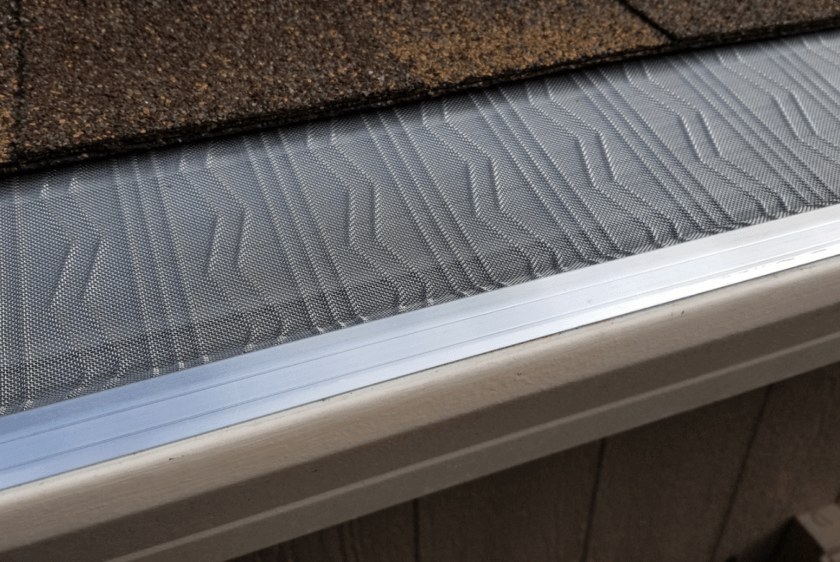
A fine stainless steel mesh stretched over a rigid aluminum frame that attaches to the gutter itself. It's the only style that checks every Michigan box: blocks debris down to shingle grit and pine needles, passes heavy rain because the mesh is formed with ridges that break surface tension, and is made of metals that don't rust, crack, or turn brittle at ten below. The catch is that quality varies — a cheap micro-mesh with a flimsy frame or a flat, unformed mesh will sag and shed water — and it needs to be installed on a sound, properly pitched gutter. Done right, it's the last guard you'll buy.
What to look for in a micro-mesh guard
- Stainless mesh, not aluminum or plastic mesh. 316 stainless is the standard to ask for; it's what marine hardware is made from.
- A rigid extruded aluminum frame, not a bent sheet-metal lip. The frame is what carries snow and ice load.
- A formed mesh profile (ridges, bends, or steps) rather than a flat screen — that's what makes water go through instead of over.
- Attaches to the gutter, not under the shingles. Lifting shingles on a Michigan roof invites leaks and can void the shingle manufacturer's warranty.
- A long, transferable, written warranty. Anything under 20 years is the manufacturer telling you what they think of their own product.
What we install
Guthix Roofing installs LeafBlaster Pro, Gutterglove's contractor-only micro-mesh guard: 316 stainless mesh, extruded aluminum frame, patented Z-Bend profile, fits 5-inch and 6-inch K-style plus fascia-mount and half-round gutters, and a 40-year transferable manufacturer warranty. We chose it because it ticks every item on the list above and because it's a product we can put our own written workmanship warranty behind without worrying. Read the full breakdown in our LeafBlaster Pro article.
Guards vs. new gutters: which first?
One thing no review site mentions: a gutter guard is only as good as the gutter under it. If your gutters are pulling away from the fascia, holding standing water, or rusted through, guards will just cap the problem. If you're within a few years of needing new gutters anyway, the cheapest path is usually new seamless aluminum runs with guards added while the crew is already there. We'll price both on the same itemized quote so you can see the numbers side by side.
Get an Honest Gutter Guard Recommendation
Guthix Roofing installs stainless steel micro-mesh gutter guards and seamless aluminum gutters across Wayne, Oakland, Macomb, Washtenaw, and Monroe counties. Michigan Residential Builder License #262600716, fully insured.