
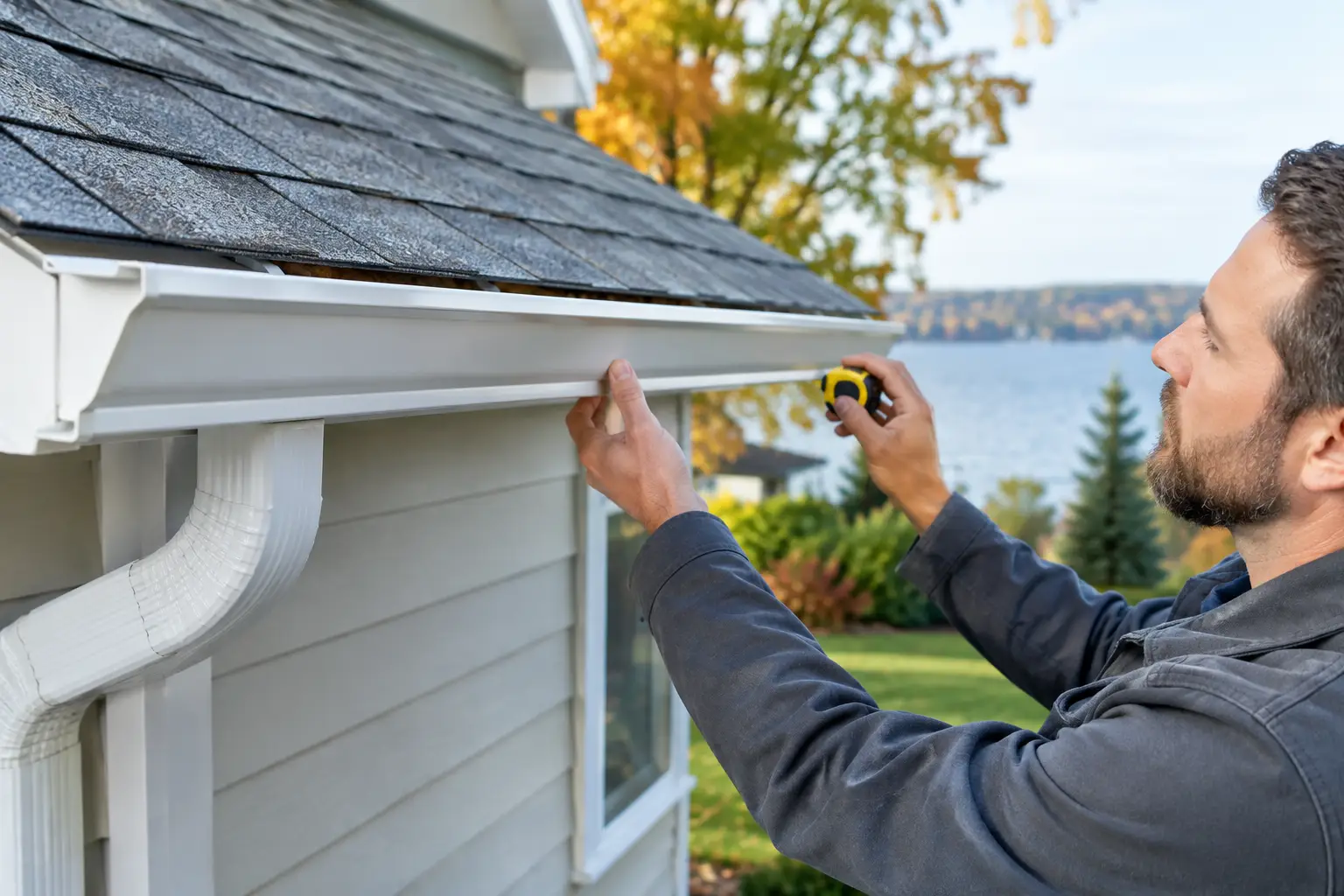
A gutter that looks fine on a dry day can still be too small for your home. The real test comes during a hard Michigan downpour, when water sheets off the roof faster than the system can carry it away. Knowing how to choose gutter size helps prevent the overflow that can damage fascia boards, landscaping, siding, foundations, and basements.
For many homes, standard 5-inch gutters work well. But “standard” is not the same as right for every roof. Your roof’s drainage area, pitch, valleys, downspout layout, and local rainfall all affect the size and capacity your gutter system needs.
Start With the Roof, Not the Old Gutters
The gutters currently installed on your house are not proof that they were sized correctly. Many older homes have undersized systems simply because 5-inch gutters were commonly installed by default. If they overflow in heavy rain, stain the siding, pull away from the fascia, or leave trenches beneath the eaves, replacement is a good time to correct the design rather than repeat it.
The first number a contractor considers is the roof area that drains into each gutter run. A long run below a large roof plane handles more water than a short run beneath a small porch roof. This is why gutter sizing should be evaluated section by section, not only by the home’s total square footage.
A simple roof with evenly divided drainage may work well with 5-inch seamless aluminum gutters. A larger roof plane, however, can send a surprising volume of water toward one section of eave. The same is true when several roof surfaces meet above one gutter run.
How to Choose Gutter Size by Water Capacity
Residential gutters are usually described by their width. The two sizes homeowners see most often are 5-inch and 6-inch K-style gutters. The difference sounds small, but a 6-inch gutter carries substantially more water than a 5-inch system.
When 5-inch gutters are usually appropriate
A 5-inch seamless gutter system is often a practical fit for a smaller or moderately sized home with a straightforward roofline. It can perform well when roof planes are not unusually steep, water is distributed across multiple runs, and downspouts are properly placed.
This option also has a lower material cost and may match the proportions of smaller eaves. Still, choosing it strictly to reduce the initial price can be expensive if the system overflows every time a heavy storm moves through. Water damage costs more than the upgrade that could have prevented it.
When 6-inch gutters make more sense
Six-inch gutters are a strong choice for many metro Detroit homes, particularly homes with broad roof planes, steep slopes, complex valleys, or recurring overflow issues. Their larger channel provides more room for fast-moving runoff during intense rain.
They are also worth considering when a home has limited places for downspouts. If the roofline or architecture prevents ideal downspout placement, a larger gutter can add useful capacity. It does not replace proper drainage planning, but it gives the system more margin during peak rainfall.
The trade-off is straightforward: 6-inch gutters cost more and have a slightly larger visual profile. On most medium and large homes, that profile is subtle. For homeowners who have seen water pour over 5-inch gutters during storms, the added capacity is usually the more valuable consideration.
Roof Pitch Changes the Calculation
A steep roof does not necessarily collect more rain than a flat-looking roof with the same footprint, but it sheds water faster. That faster runoff reaches the gutter with more force and in a shorter period of time. During a heavy storm, a steep roof can overwhelm a marginal gutter system even if the roof area does not seem exceptionally large.
Pitch is especially relevant on two-story homes, homes with prominent front gables, and newer roof designs with multiple slopes and valleys. Water accelerated by a steep section can hit a lower roof plane, combine with more runoff, and then enter a single gutter run. That concentration point deserves close attention.
A qualified installer should evaluate these transitions before recommending a size. A quick quote can be helpful for budgeting, but final scope should account for the actual roof layout, drainage paths, and existing conditions at the eaves.
Valleys Need Extra Capacity
Roof valleys are where two slopes meet, directing water into a concentrated channel. They are one of the most common places for gutter overflow because they deliver a large volume of water to one small area.
A valley over a doorway, walkway, deck, or lower roof deserves particular care. In some cases, a 6-inch gutter below the valley is the sensible choice even if other runs on the home can use 5-inch gutters. In other cases, the answer may be a larger downspout, an additional downspout, or a revised outlet location.
This is why a one-size-fits-all proposal is not enough. Gutter replacement should include a clear explanation of which runs need additional capacity and why. Homeowners should be able to see the scope, downspout locations, and line-item pricing before work begins.
Downspouts Are Part of Gutter Sizing
A larger gutter will not solve a drainage problem if water cannot exit quickly enough. Downspouts move collected water from the gutter to the ground, so their number, size, and placement matter as much as the gutter channel itself.
Common residential systems use 2-by-3-inch or 3-by-4-inch downspouts. The larger 3-by-4-inch option carries considerably more water and is often paired with 6-inch gutters or used beneath high-volume areas such as valleys. A properly designed system may also need more downspouts, especially on long gutter runs.
Downspouts should direct water away from the foundation. Extensions, underground drains, or splash blocks can all be appropriate depending on the property. What matters is that discharge does not pool next to the house or wash out mulch beds and walkways.
There is a balance to consider. Adding downspouts improves capacity, but too many downspouts can affect the appearance of the home. Good planning puts them where they do the most work while keeping the exterior clean and intentional.
Do Not Forget Gutter Guards and Debris
Gutter guards can reduce cleaning needs, but they do not increase gutter size. In fact, certain guard styles can restrict water entry during a hard rain or accumulate debris at the surface if they are poorly matched to the roof and surrounding trees.
If your home sits beneath mature trees, plan for debris management when selecting a system. Ask how the proposed guard handles leaves, pine needles, roof granules, and heavy rain. A guard should support drainage, not create a new point of failure.
The gutter itself also needs proper pitch toward the downspouts. A correctly sized gutter installed without the right slope can hold standing water, collect debris, and eventually corrode or pull away. Capacity and workmanship belong in the same conversation.
Signs Your Gutters May Be Undersized
Overflow is the clearest sign, but it is not the only one. Watch what happens during a steady, hard rain rather than judging the system by appearance alone. Water spilling over the front edge, especially near valleys, suggests the gutter or downspout capacity is insufficient.
Other warning signs include water marks on siding, rotted fascia, peeling exterior paint, soil erosion, basement moisture, or ice buildup near the eaves. Clogs can cause similar symptoms, so a clear inspection matters. If gutters are clean and still overflow, the problem is likely design capacity rather than maintenance.
What a Clear Gutter Recommendation Should Include
Before approving a replacement, ask for the proposed gutter width, downspout size, number of downspouts, and their planned locations. You should also know whether the gutters will be seamless aluminum formed on-site, how they will be secured, what color is included, and how water will be directed away from the foundation.
For southeast Michigan homeowners, it is also reasonable to ask how the system is designed for heavy rain, freeze-thaw cycles, and snow-season debris. Licensed and insured installation, a written warranty, and an itemized scope remove a lot of uncertainty from a project that should not involve guesswork.
Guthix Roofing can assess roof drainage as part of a gutter replacement conversation and explain where a 5-inch system is sufficient and where a 6-inch upgrade is justified. The goal is not to sell the biggest gutter on every home. It is to install a system that carries the water your specific roof produces, with no hidden costs and no surprises after the next storm.
The best gutter size is the one that stays ahead of your roof when the weather is at its worst. A thoughtful inspection now can protect the edges of your home, the ground around it, and the foundation below it for years to come.
Need this done on your Downriver home?
Guthix Roofing is based in Wyandotte and serves Downriver and Wayne County. See seamless gutter replacement from a licensed local roofer, or get an instant satellite-measured price — no name or phone needed to see the number.