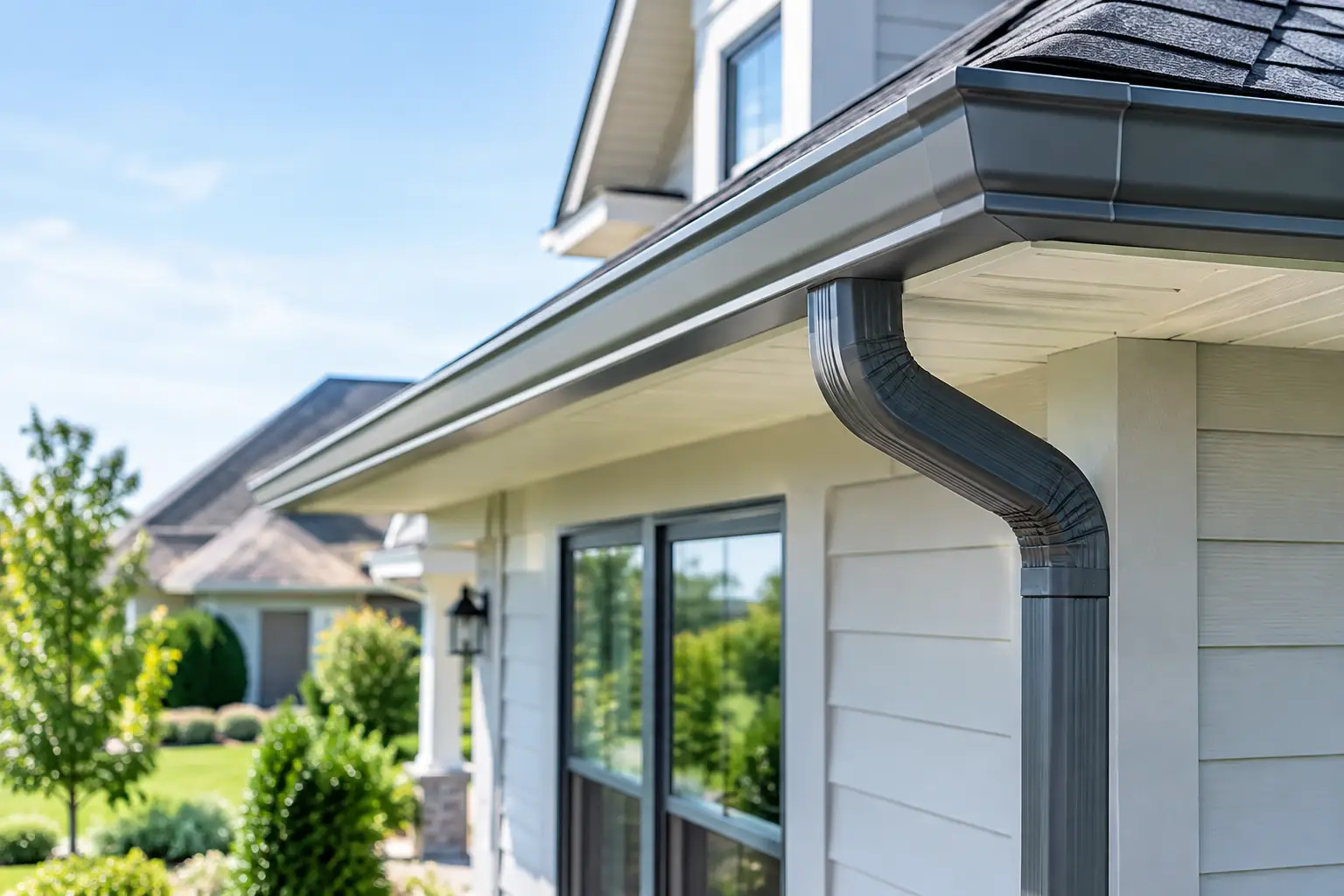

A roof can look perfectly sound from the street and still send water toward the places you least want it: behind siding, into soffits, across walkways, or against the foundation. Knowing how to evaluate roof drainage gives you a practical way to spot those risks before a heavy southeast Michigan rainstorm or spring thaw turns a small issue into a repair.
You do not need to climb onto the roof to get useful answers. Most drainage problems leave visible clues at ground level, along the gutters, and inside the attic or basement. The goal is not to diagnose every detail yourself. It is to understand where water starts, where it travels, and whether it is safely discharged away from the home.
Start With the Water's Path
Roof drainage is a system, not just a gutter. Rain and melting snow land on the roof surface, run into valleys and edges, enter gutters, travel through downspouts, and exit near the ground. From there, the yard grading and drainage route should carry water away from the foundation.
Walk around your house during a steady rain if it is safe to do so, or inspect shortly afterward. You are looking for breaks in that path. Water spilling over a gutter, pouring behind it, pooling at a downspout, or sitting next to the foundation all point to a drainage issue. A dry-weather inspection is still helpful, but rain makes the problem much easier to see.
Pay close attention to roof valleys. Valleys collect runoff from two roof planes, so they handle much more water than a straight roof edge. A small gutter or a clogged downspout beneath a valley can be overwhelmed even when the rest of the system seems fine.
How to Evaluate Roof Drainage From the Ground
Start with a slow perimeter walk. Bring a notepad or use your phone to take photos of anything that looks inconsistent. Photos are especially useful when comparing conditions after different storms or when discussing a concern with a contractor.
Look for these common signs:
- Water marks, mildew, or peeling paint on fascia boards, soffits, or siding
- Gutters that sag, pull away from the roofline, or hold standing water after rainfall
- Streaks of dirt beneath gutter seams or corners, which can indicate a recurring leak
- Eroded mulch, washed-out soil, or a trench beneath a downspout discharge point
- Puddles near the foundation, driveway, patio, or front walk
One wet spot does not always mean the roof is failing. Wind-driven rain can create temporary splash patterns, and a short overflow during an extreme downpour may be different from a gutter that overflows during ordinary rain. What matters is frequency. If the same area gets wet repeatedly, the system needs attention.
Check Gutters for Pitch, Capacity, and Obstructions
Gutters should have a subtle slope toward each downspout. You may not be able to see the pitch from the ground, but standing water hours after rain is a clear warning sign. So is water flowing over the front lip while the gutter appears partly full.
Clogs are often the simplest explanation. Leaves, maple seeds, shingle granules, and nesting material can block a gutter outlet or downspout. However, cleaning is not a universal fix. If a gutter is undersized for a large roof section, improperly sloped, or installed without enough downspouts, it can still overflow after it is cleaned.
For many homes, seamless aluminum gutters provide fewer leak-prone joints than sectional systems. Proper sizing and placement matter just as much as the material. A high-volume valley may need a larger gutter profile, an additional downspout, or a revised drainage plan. The right answer depends on the roof layout and the amount of runoff concentrated in that area.
Watch What Happens at Downspouts
A downspout should move water away from the house, not simply deposit it at the base of the wall. Check whether each downspout is firmly connected, clear of debris, and directed onto a stable splash block, extension, or underground drain route.
As a general rule, discharge should reach several feet away from the foundation and continue toward an area that slopes away from the home. The exact distance depends on lot grading, nearby hardscapes, and local drainage conditions. Water should never be directed toward a neighboring property, a sidewalk that can freeze, or a low spot that already holds water.
If you have buried downspouts, verify that the outlet is open and functioning. A concealed pipe can be clogged, crushed, disconnected, or frozen without obvious evidence at the gutter. During rain, water backing up at the top of the downspout or spilling at joints may indicate a blockage farther down the line.
Inspect the Roof Edges Without Climbing
A ladder and roof surface create real fall risks. Homeowners can evaluate a great deal from the ground with binoculars or by taking zoomed photos, but roof-level work is best left to a trained, insured professional.
From a safe position, look for shingle edges that curl, lift, or appear damaged near eaves and valleys. Check for missing drip edge, which is the metal flashing that guides water from the roof into the gutter. When drip edge is absent, incorrectly installed, or damaged, water can run behind the gutter and soak the fascia board.
Also look at the gutter attachment area. Dark staining, soft-looking wood, or gaps along the fascia can suggest long-term overflow or leakage. These conditions can affect more than appearance. Rotting fascia can weaken gutter fastening points, causing the gutter to pull away under the weight of water, debris, or winter ice.
Do Not Ignore the Ground Around the Foundation
A well-functioning roof and gutter system can still create water problems if the ground slopes toward the house. After rain, inspect the soil and landscaping around the foundation. The ground should generally fall away from the home, allowing runoff to continue outward rather than collect against the wall.
Watch for saturated soil, water stains on foundation walls, damp basement corners, or efflorescence, the white mineral residue that can appear on masonry. These signs do not prove that roof drainage is the only cause, but they are worth investigating. Foundation drainage, window wells, sump systems, and underground drains can all play a role.
This is one area where the trade-off matters. Extending a downspout may solve a simple splash-back problem, but it will not correct major negative grading. Likewise, adding soil against the foundation must be done carefully so it does not cover siding, block vents, or create a path for moisture and pests.
Account for Michigan Snow and Ice
Drainage should be evaluated for snowmelt as well as rain. In metro Detroit, freeze-thaw cycles can turn small drainage weaknesses into ice hazards and moisture damage. Gutters full of debris hold water that can freeze, expand, and strain hangers and seams. Downspout outlets that discharge onto walkways can create dangerous ice patches.
Ice dams deserve a careful distinction. They are not usually caused by gutters alone. Ice dams form when heat loss warms the upper roof, snow melts, and water refreezes near colder eaves. Clogged gutters can worsen drainage at the edge, but attic insulation, air sealing, and ventilation may be the bigger factors. A contractor should evaluate the full roof system rather than sell a gutter-only fix for every ice problem.
Before winter, clear debris, make sure downspouts are secure, and confirm that water is not being directed onto driveways or front walks. Do not chip ice from shingles or gutters with sharp tools. That can damage both materials and create a safety risk.
When a Professional Inspection Makes Sense
Schedule a professional inspection if you see recurring overflow, sagging gutters, stained fascia, interior leaks, basement moisture near a downspout area, or visible shingle damage. It is also reasonable to request an inspection after a major storm, before listing a home, or when planning a roof replacement.
A useful inspection should explain what is happening in plain language and separate immediate repairs from optional improvements. Ask for the condition of the roof edges, valleys, flashing, gutters, downspouts, and fascia to be documented. If replacement is recommended, request an itemized scope that identifies gutter size, downspout locations, drainage extensions, materials, and any wood repair needed.
For a roof replacement, drainage details should be part of the conversation from the start. New architectural shingles, flashing, drip edge, and gutters need to work together. At Guthix Roofing, that means a clear, documented scope with no hidden costs, so homeowners can see what is being replaced and why before work begins.
The best time to evaluate drainage is before the next hard rain exposes a problem for you. A few minutes around the exterior, followed by a clear professional assessment when needed, can protect the roof, the foundation, and the peace of mind that comes from knowing where every gallon of water is going.
Need this done on your Downriver home?
Guthix Roofing is based in Wyandotte and serves Downriver and Wayne County. See roof replacement from a licensed local roofer, or get an instant satellite-measured price — no name or phone needed to see the number.